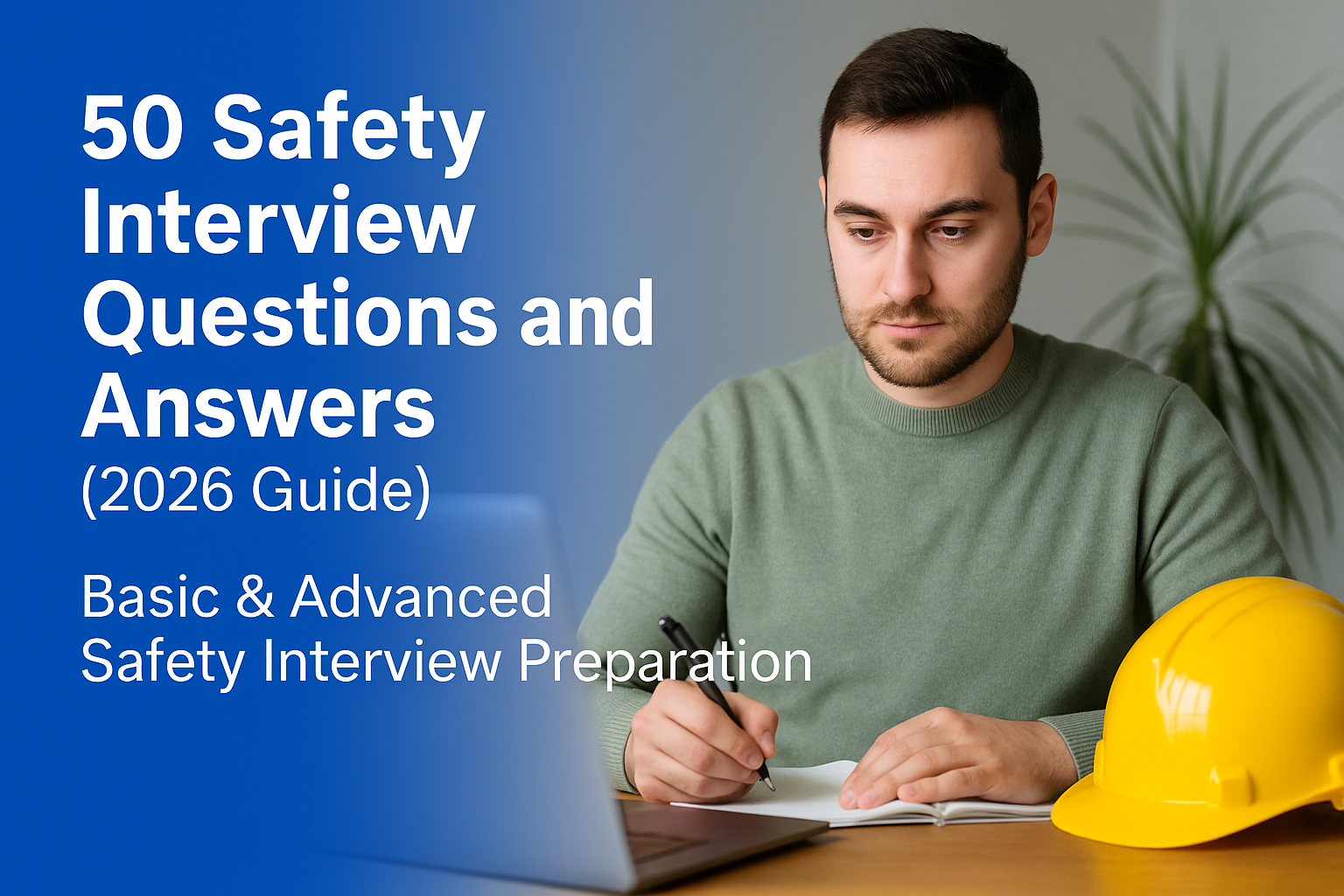
Preparing for a safety interview can be challenging, especially if you’re applying for roles such as Safety Officer, HSE Officer, Safety Supervisor, or Safety Engineer. To help you succeed, we’ve compiled 50 of the most commonly asked safety interview questions and answers, including basic safety interview questions, technical questions, and real-world safety scenarios.
This safety interview question answer 2026 guide also covers:
- Safety related interview questions
- Safety interview question answer samples
- Questions to ask a safety professional in an interview
- Safety questions to ask in an interview (for employers & candidates)
Whether you're a fresher or an experienced professional, this complete safety interview questions and answers guide will help you gain confidence and perform strongly in your next interview.

50 Safety Interview Questions and Answers – Full Guide (2026 Updated)
1. What is workplace safety?
Workplace safety refers to procedures, systems, and policies designed to prevent accidents, injuries, and health hazards at work.
2. Define hazard and risk.
A hazard is anything with the potential to harm. Risk is the likelihood and severity of harm occurring.
3. Difference between accident and incident.
An accident causes injury or damage. An incident is an unplanned event that could have caused harm but did not.
4. What is HIRA?
Hazard Identification and Risk Assessment is used to recognize hazards and evaluate risks.
5. Explain likelihood × severity.
Risk level is calculated by multiplying likelihood of occurrence with severity of consequences.
6. How do you prepare a risk assessment?
Identify hazards, analyze risks, assign controls, document findings, implement and monitor.
7. Why is PTW required?
To control high-risk activities like hot work, confined space, electrical work, and excavation.
8. Types of permits used on site.
Hot Work, Confined Space, Electrical, Working at Height, Excavation, Lifting Permit.
9. Who approves a PTW?
Safety Officer, Supervisor, or Competent Permit Issuer depending on site policy.
10. Steps in a safety inspection.
Plan, inspect, document findings, report, assign corrective action, verify closure.
11. What is non-conformity?
A deviation from safety standards, procedures, or legal requirements.
12. Difference between inspection and audit.
Inspection is routine and task-focused; audit is formal and system-focused.
13. Classes of fire.
Class A–solids, B–liquids, C–gases, D–metals, K/F–oils, Electrical fires.
14. What is an assembly point?
Designated safe area where people gather during emergencies.
15. Key components of an emergency plan.
Alarm, evacuation routes, responsibilities, communication, drills.
16. What is a root cause?
The fundamental reason an incident occurs.
17. Steps in incident investigation.
Secure area, gather evidence, interview witnesses, identify root cause, recommend actions.
18. Why is reporting important?
It helps prevent recurrence and improves safety performance.
19. What is PPE?
Equipment used to reduce exposure to hazards.
20. Types of PPE used in construction.
Helmet, gloves, goggles, safety shoes, harness, masks, ear protection.
21. How do you ensure PPE compliance?
Training, supervision, enforcement, inspections, registers.
22. What is scaffolding?
Temporary structure supporting workers and materials during construction.
23. What is a lifeline?
An anchorage system for fall protection.
24. Working-at-height precautions.
Use guardrails, fall arrest systems, proper ladders, inspections.
25. Structure of ISO 45001.
Context, Leadership, Planning, Support, Operation, Evaluation, Improvement.
26. What is a safety policy?
A company’s formal commitment to workplace safety.
27. Difference between SOP and Work Instruction.
SOP explains the process; Work Instruction gives step-by-step actions.
28. What is BBS?
BBS is Behavior-Based Safety focuses on reducing unsafe behaviors.
29. Why do workers behave unsafely?
Lack of training, awareness, peer pressure, habits, shortcuts.
30. How to improve safe behaviors?
Observation, feedback, reinforcement, training, leadership support.
31. What is job safety analysis (JSA)?
Breaking tasks into steps to identify hazards and implement controls.
32. What is ergonomics?
Designing work to fit human capability and reduce strain.
33. What is an SDS?
Safety Data Sheet giving chemical hazard, PPE, and emergency info.
34. Chemical spill response steps.
Isolate, contain, neutralize, clean, dispose properly.
35. What is waste segregation?
Separating waste into categories for safe disposal.
36. What is TWA?
Time-Weighted Average noise exposure limit (usually 85 dB/8 hrs).
37. What is machine guarding?
Physical barriers to prevent contact with moving machinery parts.
38. What is LOTO?
Lockout Tagout isolates energy sources during maintenance.
39. What is emergency preparedness?
Planning resources and training to respond effectively to emergencies.
40. What is an ESD?
Emergency Shutdown system to stop operations safely.
41. Difference between corrective and preventive action.
Corrective fixes problems; preventive avoids future issues.
42. What is risk matrix?
Tool evaluating risk by mapping likelihood vs severity.
43. What is a safety audit?
Formal evaluation of safety systems and compliance.
44. What is toolbox talk?
Short safety meeting held before work begins.
45. What is permit issuer responsibility?
Verify hazards, controls, competence, and safe conditions before work begins.
46. What is a near-miss reporting benefit?
Identifies hazards before they cause harm.
47. What are leading indicators?
Proactive measures predicting incidents (training, inspections).
48. What are lagging indicators?
Measures of past incidents (LTI rate, AFR).
49. What is a safety culture?
Shared values and behavior prioritizing safety.
50. What makes a good Safety Officer?
Strong communication, hazard recognition, technical skill, documentation, leadership, and proactive approach.
Want to Pass Your Safety Interview With Confidence? Start Training With Redhat Safety
If you want to strengthen your knowledge beyond these safety interview questions and answers, Redhat Safety offers government-approved and internationally accredited training programs that prepare you for real industry situations.
Our Most Popular Safety Course Programs:
- Safety Officer Course
- BSS Industrial Safety Course
- Fire and Safety Course
- Scaffolding Inspector Course
- ESC IDHSE & ESC General Certificate Courses
- Lead Auditor Certifications – ISO 14001, ISO 45001 & ISO 9001
- Level 7 International Diplomas – OHSM & PSM
- ASP/CSP Training Course
Start learning practical safety skills, improve your interview performance, and boost your chances of landing high-demand HSE jobs in India or the Gulf. Start learning with Safety Course in Chennai Online.
FAQs for 50 Safety Interview Questions and Answers - 2026 Updated
What are the most common safety interview questions?
Common safety interview questions include hazard identification, PPE usage, PTW procedures, HIRA, emergency response, LOTO, and incident investigation. Employers use these questions to check your understanding of basic safety principles and workplace safety standards.
How do I prepare for a safety officer interview?
To prepare effectively:
- Review basic safety interview questions and answers
- Understand safety laws, PPE, risk assessment, and incident reporting
- Study PTW systems and ISO 45001 structure
- Practice explaining safety concepts clearly
- Prepare real examples from your experience
What are basic safety interview questions for freshers?
Basic questions usually include:
- What is a hazard?
- What is a risk?
- What is PPE?
- Difference between accident and incident
- What is an emergency assembly point?
These help interviewers assess your foundational safety knowledge.
What safety-related interview questions do employers mostly ask?
Employers commonly ask:
- What is HIRA?
- What is JSA?
- What types of fire classes exist?
- How do you conduct a safety inspection
- What is LOTO?
These safety related interview questions test your ability to manage real workplace hazards.
What is the best way to answer safety questions in interview?
Follow the STAR method:
Situation → Task → Action → Result
Give clear, structured answers and relate them to real safety controls such as hierarchy of controls, PTW, PPE, and emergency procedures.
What questions should I ask in a safety interview?
Candidates can ask:
- What are the main hazards at this site?
- What safety systems do you follow (PTW, LOTO, inspections)?
- How does your company support safety training?
These safety questions to ask in an interview show confidence and professionalism.
What questions should employers ask a safety professional?
Employers should ask:
- How do you conduct an incident investigation?
- How do you handle non-compliance?
- Explain your experience with audits and inspections
These help evaluate a candidate’s technical and leadership abilities.
Are safety interview questions different for oil & gas and construction?
Yes, both are different.
- Oil & Gas: PTW, gas testing, H2S, confined space, PSM
- Construction: working at height, scaffolding, lifting operations
But basic safety interview questions remain similar across industries.
What are the best resources to study for a safety interview?
The best resources include:
- Redhat Safety’s online safety course
- Safety officer training materials
- ISO 45001 framework
- PTW procedures
- HIRA & JSA templates
Do I need a safety course to pass a safety interview?
While not mandatory, completing a safety course or industrial safety course significantly increases your confidence and job readiness. It gives you the knowledge needed to answer safety interview questions and answers effectively and perform well in real job roles.